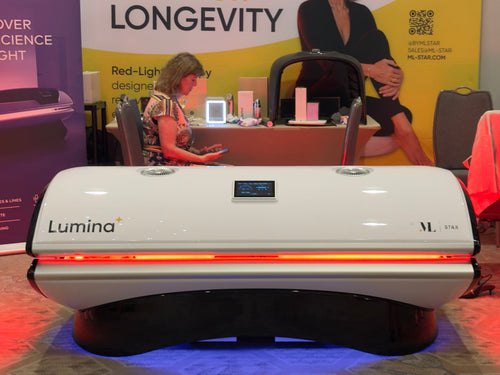

Light therapy has become one of the fastest-growing technologies in wellness, aesthetics, sports recovery and longevity. Yet one question comes up repeatedly:
What's the difference between red light and near-infrared light?
Although these wavelengths are often used together, they interact with the body differently. Understanding how they work—and why professional devices combine multiple wavelengths—can help explain why some systems deliver more versatile treatments than others.
What Is Red Light?
Red light belongs to the visible spectrum, meaning it can be seen by the human eye. Most professional devices use wavelengths between 630 and 660 nanometers (nm).
At these wavelengths, light primarily interacts with superficial tissues, making it well suited for applications involving the skin.
Common areas where red light is being studied include:
- Skin appearance
- Collagen production
- Fine lines
- Skin texture
- General skin wellness
Because red light does not penetrate as deeply as near-infrared light, its primary interaction occurs closer to the surface.
What Is Near-Infrared Light?
Near-infrared (NIR) light is invisible to the human eye.
Professional light therapy systems commonly use wavelengths ranging from 810 to 940 nm.
Unlike visible red light, near-infrared photons penetrate deeper into biological tissues.
This allows them to reach structures beneath the skin, including muscles and connective tissues, which is why they are frequently included in professional wellness and recovery devices.
Researchers continue to investigate near-infrared light across multiple fields, including:
- Exercise recovery
- Temporary muscle soreness
- Joint comfort
- Circulation
- Performance recovery
How Deep Does Each Wavelength Go?
Although penetration depth varies depending on the individual and treatment conditions, a simple way to think about the difference is:
Red Light
Mainly interacts with superficial tissues.
Ideal for skin-focused applications.
Near-Infrared
Travels deeper through tissue.
Better suited for muscles, connective tissues and deeper structures.
Rather than replacing one another, these wavelengths complement each other.
Why Professional Devices Combine Multiple Wavelengths
One of the biggest misconceptions about light therapy is that a single wavelength can do everything.
Professional systems often combine several wavelengths because different tissues absorb light differently.
For example:
- 633 nm — commonly used in skin-focused applications.
- 660 nm — another widely used visible red wavelength.
- 850 nm — frequently included for deeper tissue applications.
- 940 nm — often incorporated into multi-wavelength systems.
Using multiple wavelengths allows one treatment session to target different tissue depths rather than relying on a single spectrum.
This is one reason why professional devices differ significantly from many entry-level consumer products.
Not All Light Therapy Devices Are Equal
Two devices may both advertise "red light therapy," yet perform very differently.
Several engineering factors influence the overall treatment experience, including:
Optical Power
The amount of usable light reaching the treatment area.
Uniform Light Distribution
Professional systems aim to provide consistent coverage across the body rather than creating hotspots.
Treatment Area
Larger treatment areas can reduce session time and improve convenience.
Thermal Management
Proper cooling helps maintain stable performance throughout treatment sessions.
Build Quality
Medical-grade components are designed for frequent professional use.
Common Misconceptions
"More LEDs Always Means Better Results."
Not necessarily.
The number of LEDs alone does not determine device performance. Wavelength selection, optical design, irradiance, treatment protocol and overall engineering all contribute to how a system performs.
"Near-Infrared Is Heat."
Near-infrared light is electromagnetic radiation, not heat itself.
Some devices may generate warmth during operation, but near-infrared light should not be confused with infrared heating technologies.
"You Can Feel It Working."
Many people expect light therapy to create a strong physical sensation.
In reality, treatments are often gentle. The absence of intense heat or discomfort does not indicate that the device is ineffective.
Choosing the Right Wavelength
The appropriate wavelength depends on the intended application.
Generally speaking:
| Goal | Commonly Used Wavelengths |
|---|---|
| Skin appearance | Red light (around 630–660 nm) |
| Surface tissues | Red light |
| Deeper tissues | Near-infrared |
| Full-body wellness | Combination of red and near-infrared |
Professional systems frequently combine both rather than forcing users to choose one.
Why Multi-Wavelength Systems Matter
Human tissue is complex.
No single wavelength interacts with every tissue in exactly the same way.
Combining multiple wavelengths enables broader treatment possibilities while allowing practitioners to tailor protocols to individual goals.
This approach is one reason many professional clinics choose systems capable of delivering several wavelengths within the same session.
Frequently Asked Questions
Can you see near-infrared light?
No. Near-infrared light is invisible to the human eye, although some devices may emit a faint glow from nearby visible wavelengths.
Is red light better than near-infrared?
Neither is inherently better.
They interact with different tissue depths and are often complementary.
Why do professional systems use multiple wavelengths?
Different wavelengths interact with different tissues. Combining them allows practitioners to deliver more versatile treatments.
Does more power always mean better treatments?
Not necessarily.
Treatment quality depends on multiple factors including wavelength selection, optical engineering, treatment protocol and device design.
Conclusion
Red light and near-infrared light serve different purposes.
Rather than competing, they complement one another by interacting with different tissue depths.
This is why many professional-grade light therapy systems incorporate multiple wavelengths into a single platform, allowing practitioners to deliver versatile treatments tailored to different needs.
As research into photobiomodulation continues to evolve, understanding these differences helps both professionals and consumers make more informed decisions.
Interesting in learning more
Interested in learning more about professional light therapy systems?
Explore the ML-Star collection or contact our team to discover solutions designed for clinics, wellness centers and longevity professionals.