
Most clinic owners meet light-based technology the wrong way round. A distributor leads with the device, the specification sheet and the price, and the operational questions only surface weeks later, usually after a deposit has been paid. By then the real constraints are already fixed: which room the unit will live in, who is qualified to run it, and what it does to a schedule that was already tight.
This article works in the other direction. It sets out the operational questions worth answering before you evaluate any specific device, so that when you do compare models you are comparing them against your own clinic rather than against a brochure.
1. Define the clinic objective first
A device is not an objective. Before anything else, write down in one sentence what the addition is supposed to do for the business. In practice, owners tend to be pursuing one of a small number of aims:
- Add a service that can be delivered without occupying a senior practitioner for the full session.
- Give existing clients a reason to return between higher-ticket appointments.
- Fill known dead periods in the week rather than add to peak-hour congestion.
- Broaden the menu so the clinic reads as a fuller offering to new enquirers.
These aims pull in different directions. A service designed to fill quiet Tuesday mornings has different requirements from one designed to raise average spend on a Saturday. Naming the objective early stops you from evaluating every device against every possible benefit and concluding, unhelpfully, that they are all attractive.
2. Assess room and equipment footprint
The first hard constraint is physical. Light-based systems vary widely in format, from compact units that sit on an existing treatment couch to full-body systems that need dedicated floor area and clearance on more than one side.
Measure the candidate room rather than estimating it, and record:
- Usable floor area once the couch, trolley and storage are in place.
- Clearance needed around the unit for positioning and for the client to enter and leave safely.
- Ceiling height, if the system is overhead or on an articulated arm.
- Power requirements, socket position and whether a dedicated circuit is specified by the manufacturer.
- Ventilation and ambient temperature, since some rooms become uncomfortable with additional equipment running.
- Whether the unit can be moved between rooms in practice, or whether it will realistically stay where it is installed.
The question that decides most cases is not whether the device fits, but whether it fits without displacing something that already earns. A unit installed in your only flexible room converts a room that could host anything into a room that hosts one thing. That may be the right trade, but it should be a decision rather than a discovery.
3. Map staff involvement and training
Ask three separate questions, because they have different answers:
- Who sets the session up? Positioning, settings and client preparation.
- Who supervises during the session? Continuous presence, periodic checks, or neither, according to the manufacturer's instructions and the rules that apply where you practise.
- Who resets the room afterwards? Cleaning, checks and turnover.
The gap between "a practitioner is occupied for the whole session" and "a trained assistant sets up and returns at the end" is the single largest driver of whether the service is operationally comfortable. It changes staffing cost per session, it changes who else can be seen during that window, and it changes how many sessions a day are realistic.
Training requirements, permitted scope of practice and supervision rules differ by jurisdiction and by device classification. Confirm them with the manufacturer and with your local regulator or professional body for your specific situation. Do not assume that what a peer clinic does in another state or country is permissible in yours.
4. Evaluate treatment timing and turnover
Session length is only part of the picture. Build the full block from end to end:
- Client arrival, consultation or check-in.
- Changing and preparation.
- The session itself, as specified by the manufacturer.
- Any post-session period before the client leaves the room.
- Cleaning, resetting and any device cool-down or maintenance step.
A session that is described as short can still consume a much longer room block once these are added. Write the full block down and compare it against the appointment slots your booking system actually uses. If the natural block is forty minutes and your system works in thirty-minute increments, you have a scheduling decision to make before you have a device decision.
5. Consider schedule capacity and customer flow
Now place the block into a real week. Take last month's diary and mark the periods where the candidate room was genuinely free. Two patterns tend to emerge.
If the free capacity sits in the quiet parts of the week, the service has to be one that clients will travel for at those times, or one that can be attached to an appointment they were already making. If the free capacity sits at peak times, adding the service competes directly with treatments you already sell, and the relevant comparison is not "new revenue versus nothing" but "this service versus what that room would otherwise have done".
Also consider flow through the rest of the premises. Additional appointments mean additional arrivals, additional reception handling, more pressure on changing areas and, in some layouts, more people waiting in a space that was sized for fewer. These constraints are easy to overlook and awkward to fix afterwards.
6. Review implementation and support
Operational fit continues after installation. Establish, in writing, before you commit:
- What delivery and installation involve, and what the clinic must prepare beforehand.
- What training is provided, in what format, and whether it covers new staff later.
- Routine maintenance tasks, who performs them, and how long they take.
- Consumables or replaceable parts, their expected life and how they are ordered.
- Warranty terms, and what the process and realistic timeline are if the unit is out of service.
- Who to contact for technical support, and during which hours.
Downtime is an operational risk, not just a commercial one. Once a service is on the menu and in the booking system, a unit that is unavailable for a fortnight means rebooking clients and absorbing the disruption. Understanding the support path in advance is part of assessing fit.
7. Assess commercial fit without guaranteed outcomes
No supplier can tell you what a device will earn in your clinic, and you should treat any specific return figure with caution. What you can do is build your own model from numbers you control.
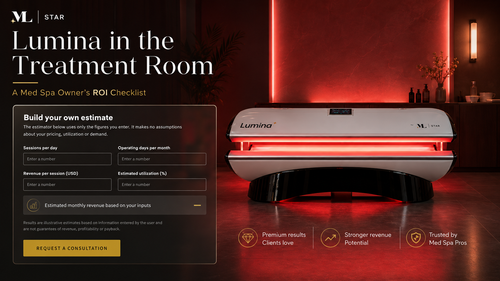
Set out the total cost of ownership: acquisition or financing, installation, training, consumables, maintenance and the staff time consumed per session. Then set out the capacity you identified in section 5, at a session price that is realistic for your market rather than aspirational. That gives you a break-even volume expressed in sessions per week.
The useful question is not "will this be profitable?" but "is that weekly session count plausible given my current client base and the free capacity I actually have?" Test it against a conservative case as well as an expected one. If the plan only works at high utilisation from the first month, the plan is fragile.
Finally, be honest about the softer benefits. A broader menu can help with retention and positioning, and those effects are real, but they are difficult to attribute and should not be used to rescue a model that does not work on its own terms.
Conclusion
Room, staff and schedule decide whether a light-based service works in practice. A device that fits the room but occupies a senior practitioner for an hour, or one that suits the staffing model but only has free capacity at times clients will not attend, will underperform regardless of its specification.
Work through the seven sections above with your own measurements and your own diary before you shortlist any model. The clinics that integrate this kind of technology smoothly are almost always the ones that answered the operational questions first.
Contact the ML-Star team to discuss how professional light-based technology could fit into your clinic’s rooms, staffing and treatment workflow.